
Environmental policies are prone to discursive ritualization as an alternative to action. It is enough to invoke a few elements of the environmental mantra for a generalized "feel-good" factor to immediately reassure the public. If the political discourse moves toward legislation, the sense of accomplishment is even stronger. Influenced by a belief in the power of law—a belief inherited from the ideals of the French Revolution—we think a legislative act is enough to solve any problem.
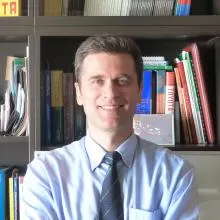
As a former legislator and a man of the law, qualified by the Lisbon Faculty of Law and authorized by the Bar Association for over 25 years, I am somewhat skeptical of the law's ability to change reality at the speed announced by policymakers. Reality tends to resist the legislator, and the multiplication of successive and contradictory laws tends to preserve that reality.
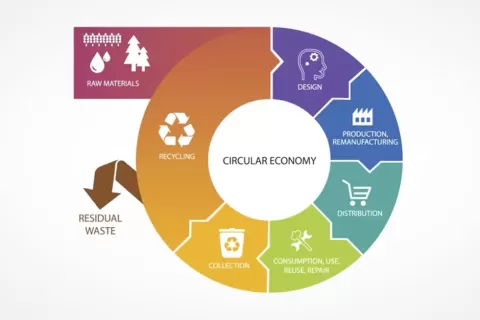
This introduction serves to contextualize my skepticism and allow for a transition to a higher level, moving from the national legislator to the European Union legislator. I would like to dwell on one of the European Commission's most recent initiatives: the circular economy package.
For those less familiar with the legislative production method in Brussels, a warning is necessary. Between the legislative initiative—assigned by the Treaties exclusively to the European Commission—and the final result published in the Official Journal of the European Union, much can happen. Two or four Presidencies of the Council of the European Union may pass, each with different political agendas; many of the 28 Member State delegations sitting at the Council table will weigh in; it will pass through the European Parliament, first through the Environment Committee and then the plenary; there will be various and contradictory impact assessments; and thousands of lobbyists based in Brussels will have their say. The final result of the legislative procedure can be very different from what was in the European Commission's original initiative.
Often, in environmental policy, the final result of the legislative procedure translates into symbolic legislation, with limited or even impossible application. Such pieces of legislation are like those decorative objects placed on tables to show guests, but which we remove whenever the table actually needs to be used.
Symbolic legislation is harmless regarding the solution of environmental problems. However, it is not harmless when it increases bureaucracy and context costs, making life harder for families and companies. And this symbolic legislation becomes dangerous when it hinders existing technical solutions on the market that are sold at reasonable prices with adequate levels of environmental protection.
The circular economy is a good idea, but it is not a new idea. In Portugal, there are numerous areas of waste management where the private sector offers integrated solutions that are an application of the best intentions of the circular economy announced by Brussels.
I fear that the Portuguese legislator, when we reach the transposition phase of the future Directives, will want to add another dose of bureaucracy ("gold-plating"), making the application of European Union standards even more difficult and threatening the continuity of the virtuous examples we have in Portugal regarding waste management.
José Eduardo Martins
I am Rui Fernandes and I graduated in Chemical Engineering from the University of Coimbra (1998-2003). In a few words, I will try to describe my career so far as a Chemical Engineer and how the degree in Chemical Engineering at the University of Coimbra influenced me, both as a person and as a professional.
After finishing the course, I soon began working in industrial environments, finding my first job in Entroncamento at the company "Torrejana" as a shift supervisor. This was the first Biodiesel plant in the country and I had the opportunity to participate in the end of its construction and startup, quickly exposing me to totally new environments different from the University, with contact with civil construction, engineering, electricity, and industrial maintenance companies, etc. The plant startup was perhaps the first big test of much of the content learned at the university, requiring a high capacity for data interpretation in reactors, distillation columns, centrifugation processes, decanting, among others, with great interconnection with the laboratory and quality control.
After 3 years, I moved to Lisbon to the company "Biovegetal", another biodiesel plant still under construction, again passing through environments of contact with engineering and construction companies, etc. This aspect ended up being very important, as being part of two plant startups was crucial to expose me to all the aspects necessary in the industrial world to start an industrial unit. For a Chemical Engineer, this is an ideal scenario: being able to see how the equipment works on the inside and being able to participate in its engineering, construction, installation, production, health and safety. All the college years where we learned to size reactors, or distillation columns, or to understand heat transfer in exchangers, etc., were crucial to understand how everything works, leading me later to be part of the plant's process optimization team. The intense group work to which we are exposed during the course was clearly fundamental to gaining an above-average work capacity. Many were the night shifts I spent by my own choice in the laboratory doing experiments that would later be implemented on the production line. Clearly, the extensive laboratory classes at DEQ helped me gain a taste for this side.
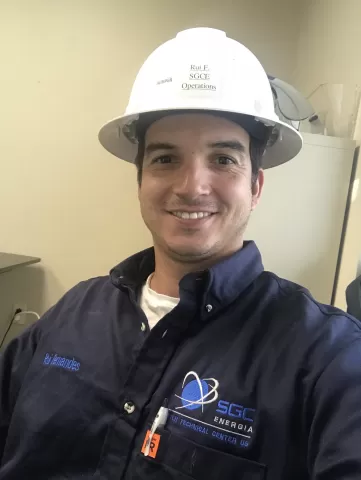
This capacity to work in industrial environments, to handle/lead engineering projects and mainly the capacity to work and lead teams, led to me moving in 2010 to a project in Austria, with the SGC Energia group. The goal was to be part of the engineering and production team of an innovative project: GTL: Gas-To-Liquids: building a pilot plant for the production of synthetic fuels from syngas (H2 and CO), produced through biomass gasification. It was perhaps the best project I have been involved in so far. Working as production manager, I led multicultural teams with 7 different nationalities, being part of the engineering team, implementing an innovative technology. It was something fantastic and unique and allowed me to grow tremendously as an engineer.
After 2 years, a new project appeared also with SGC Energia but in the USA in Houston, Texas, where I have remained since then. I led the engineering and production team of a new GTL pilot unit (with different reactors), supervising its construction (in the state of Alabama) and subsequent transport and installation of the unit in Houston, state of Texas. And all this good performance led to me being considered to be part of the first commercial GTL unit in the USA, in the state of Louisiana. Today I am part of the engineering team that leads the construction project of an 1100 BPD (barrels per day) unit of synthetic fuels from natural gas. Construction is still ongoing and the startup is planned for the end of 2018. In addition to responsibilities as a process engineer, I am also responsible for the technical evaluation of all catalysts and chemicals in the plant, managing the process license with our client. This grand and imposing project has been an absolutely enriching and rewarding experience: a Chemical Engineer graduated from the DEQ of the University of Coimbra being part of the engineering, manufacturing and implementation, commissioning and startup of the first GTL plant in the USA!
It was at this time that I began to realize the following: after having worked for a few years with people from all over the world, I understand that having done my degree at DEQ at the University of Coimbra was an added value as a Chemical Engineer. The enormous work capacity, the range of knowledge gained through the various subjects learned (from chemical reactors to economics, from unit operations to chemical laboratories), the countless group works with course colleagues, everything, everything, everything led me to have reached where I am today and not to be afraid or wary of the future. But I think the greatest lesson of all that I took from the course was... to always be learning a little about everything. Just like at DEQ, I learn every day in my work, with everything and everyone. So much so that my philosophy is: if the day comes that I stop learning.... then it is time to change jobs.
This is my experience in the world as a Chemical Engineer graduated from DEQ.
But it won't stop here...
Rui Fernandes
The 13th International Chemical and Biological Engineering Conference (CHEMPOR 2018) took place between October 2nd and 4th in Aveiro, co-organized by the University of Aveiro and the Order of Engineers.
CHEMPOR has been organized regularly in Portugal since 1975 and returned to Aveiro for the second time. This series of conferences is a forum for discussing recent developments and future directions in different areas of chemical engineering, materials science and engineering, biotechnology, and biological engineering. Traditionally, CHEMPOR is a dynamic meeting of scientists and professionals from industry and academia, and it has the institutional sponsorship of the Portuguese Chemical Society and the Portuguese Biotechnology Society.
The general topics for CHEMPOR 2018 were:
Biological Engineering and Biotechnology
Biorefinery and Sustainability
Reaction and Separation Processes
Energy and Environment
Innovative Materials and Applications
Synthesis, Integration, and Intensification of Chemical Processes
Multiscale and Multidisciplinary Engineering Education.
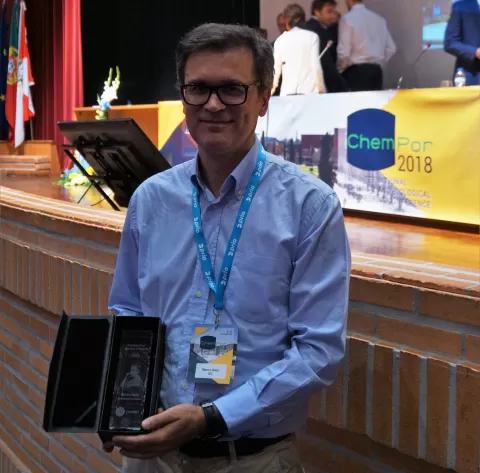
Paralab has once again presented the Professor Almiro e Castro Award during the CHEMPOR 2018 event.
The Professor Almiro e Castro Award is an award established by Paralab that aims to distinguish the scientific merit of a teacher/researcher of Portuguese nationality, under the age of 45, who has stood out in the last 3 years in the fields of Chemical Engineering, Biological Engineering, and related areas. This award is presented every three years.
It was with great satisfaction that we received the news that the winner of this edition was Dr. Marco Reis, a professor at the Department of Chemical Engineering of the University of Coimbra and president of the board of PRODEQ.
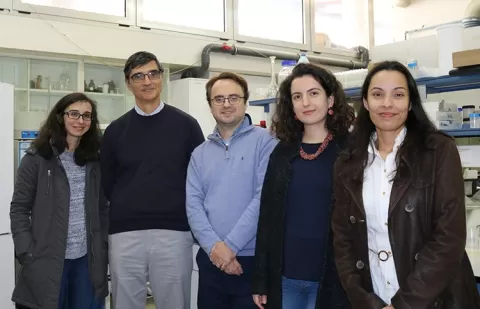
For the first time, an almost one hundred percent natural molecule has been developed capable of replacing styrene, a petroleum-derived molecule that is at the core of materials used in the most diverse industries, such as naval, automotive, packaging, and clothing, but which presents high toxicity.
The research that led to the new "green" molecule, developed by a team from the Department of Chemical Engineering of the Faculty of Sciences and Technology of the University of Coimbra (FCTUC), is the cover story of the scientific journal Green Chemistry, one of the most prestigious journals in the field of green chemistry.
The study coordinators, Ana Fonseca and Arménio Serra, clarify that «the scientific community has long studied an alternative to styrene, a compound considered toxic and quite harmful to the environment and to humans, having been classified as a carcinogenic agent. Until now, attempts to replace styrene have not proven satisfactory, essentially because they did not ensure the best properties of the final material.»
The greatest challenge of this research was to develop a molecule based on natural products that can be used in the same functions as styrene and that, after the same treatments, allows for obtaining materials with the same mechanical and thermal properties.
The new molecule is based on «sobrerol, a cyclic structure compound that can be obtained from the transformation of materials extracted from pine resin. The preparation of sobrerol also involves the use of carbon dioxide (CO2) as a raw material, which is an important added value from an environmental point of view,» describes Ana Fonseca.
In order for the new molecule to guarantee the same final properties and characteristics very similar to those of styrene, the team had to modify the sobrerol compound through specific molecular engineering reactions.
Currently, styrene is one of the most widely used compounds industrially, with consumption expected to grow by 4.9% between 2018 and 2023 (https://www.mordorintelligence.com/industry-reports/styrene-market). Thus, the molecule invented by the FCTUC team could have a major impact on industry. However, it is necessary to «carry out the required technological development studies for its application,» the research coordinators conclude.
Source: FCTUC (Cristina Pinto)
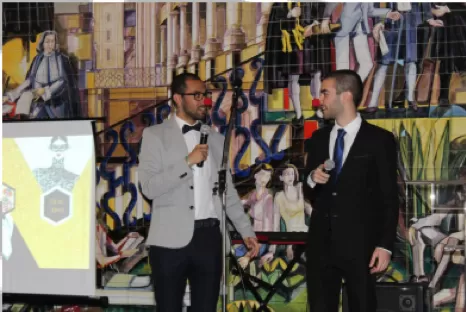
One of the most anticipated activities of the entire year, the Gala Reatores d’Ouro (Golden Reactors Gala), took place on April 24th, under a slightly different format. The usual categories were presented by two energetic hosts: João Pedro Almeida and Samuel Barros. They not only presented them but also took part in the night's performances. This edition featured numerous new features, one of them highlighted by the photo, where the presenters are wearing a red nose. The gala joined forces with Operação Nariz Vermelho, an association whose goal is to ensure the joy of everyone passing through hospital pediatric services.
Another novelty in this gala, in the form of a tribute, arose due to the unfortunate events that struck our country in 2017. It consisted of raising awareness about the problems caused by fires, led by Mariana Alvim and a guest firefighter. A moment when jokes were set aside to give a voice to something more serious.
Nowadays, no one can go more than five minutes without looking at their phone. Not forgetting this facet of current generations, the Culture department created small quizzes in which anyone with a smartphone and internet access could participate. The fastest to get the answers right were rewarded with a small sweet. (Don't worry, the copyrights for this modality were duly purchased from Professor Pedro Saraiva).
This year was particularly rich in performances. Representing the oldest and most solemn student tradition, the female academic group "As Mondeguinas" was present. We discovered new talents, namely João Almeida's rapper side, Marta's fantastic voice, we stepped a bit away from the usual with more alternative music with Guilherme, Igor's magic tricks, and we were once again enchanted by Samuel's fantastic voice. We never thought we would find so many artists among books, exams, and the stress of an engineering student. Since it was impossible to fairly name the best performance of the night, a prize was awarded to all participants.
Lastly, let's remember the grand winners of all categories:
Timon and Pumba (formerly Tico and Teco) - Eva and Telma
Exemplary Student - Patrícia Almeida
Reator D'Ouro - Mariana Alvim
Professor of the Year - Pedro Simões
Freshman of the Year - Tiago Silvestre
Bohemian - Daniela Pereira
Denner Nunes - NEDEQ
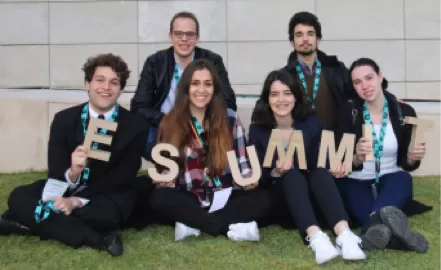
The first edition of E-Summit took place at the Department of Chemical Engineering of the Faculty of Science and Technology of the University of Coimbra and at the Order of Engineers of the Central Region on April 13th and 14th, respectively. This event was the result of joint efforts between the Training and Professionalism Department of the Chemical Engineering Students' Union of the Academic Association of Coimbra and the Division of Innovation and Knowledge Transfer of the University of Coimbra (DITS) through the Académica Start UC program.
This initiative aimed to provide students with a closer look at the labor market, their possible employment options, and also to show what the life of a chemical engineer is like right after obtaining their degree. The goal was to bring DEQ students and companies closer together to create greater synergy, making the process easier for both in the near future.
The event was attended by renowned companies not only in Portugal but worldwide, as well as younger companies born from innovation and disruption. In total, eight companies were present: Innovnano, Omya, Tucab, Cimpor, Philip Morris, Bluepharma, and C-Brain. These could well be an opportunity for future recent graduates. We also had lectures by Daniela Rosa from DITS and Jonathan Torres from IIIUC, who spoke to us about their academic career paths. These testimonies motivated the students present and encouraged them to think outside the box, showing the importance of multidisciplinarity, innovation, and entrepreneurship in today's job market.
Parallel to this, the debate "Teaching Strategies – The Future of Engineering" took place at the Order of Engineers, bringing together representatives from various engineering education institutions in Portugal, namely the University of Coimbra, the Superior Institute of Engineering of Coimbra, and the Instituto Superior Técnico of Lisbon. Important issues regarding this topic were discussed.
E-Summit was considered a success by participants, speakers, and organizers, with high attendance across all its events.
We express our gratitude to all those who supported us, namely the University of Coimbra, the Academic Association of Coimbra, the Order of Engineers of the Central Region, and the participating companies, as well as our partners: PRODEQ and Académica Start UC.
Denner Nunes - NEDEQ
Link to E-Summit photos: Photos